What Odysseus Leaves Behind
Dom Rottman
31 July 2026
Christopher Nolan’s The Odyssey is a spectacular treat which pushes the practical limits on the imagination. Yet as usual technical achievement and beauty is the Trojan Horse which smuggles in the devious spirits of ideology. The standards of civilization are to be taken as seriously and objectively as those against which his talent is measured. As a myth within a myth Nolan expresses mastery of his craft.
To adapt the Odyssey is to choose a greatly unfair task. It is some 100,000-odd words long, originally written down in an ancient language, originally composed in 12,109 lines of poetic verse that was not meant to be read but had a rhythmic quality that was meant to be sung. We are literally and literarily worlds away from experiencing it “properly”—and odds are nobody heard it the same way twice even back then. And while all translators go to heaven, simply doing difficult things does not earn you esteem on earth. Nolan should not be getting any more credit for adapting the Odyssey than he should for adapting Batman, even though the former has two to three thousand more years of impact than the latter. Adaptations, more so than other creative works, are defined by what choices are made. And Nolan has certainly made several of them.
Among such choices, to the ire of mythology lovers, is the way the film adapts the encounter with Polyphemus the cyclops. In the Odyssey, Odysseus, trapped with his men in Polyphemus’ cave by a giant stone, devises a plan to escape by drilling a giant stake of burning wood into the cyclops’ eye and then leave by tying themselves to the underbelly of his sheep. Odysseus shares his “name”–Οὔτις, meaning “nobody”—with Polyphemus over some wine before the giant falls asleep. Awakened by the excruciating pain of burning wood splintering off into his retina, Polyphemus cries out “Nobody is hurting me!” a call unheeded by his cyclops brethren. Having escaped offshore, Odysseus taunts Polyphemus by shouting back that if anyone asks who blinded him, he should answer “Odysseus.” Polyphemus then promptly tells his father—Poseidon. In contrast, in Nolan’s film Odysseus and his men happen upon Polyphemus’ cave in search of food, and escape in a similar fashion—they stab a stake of burning wood into the giant’s eye, and leave the following morning bundled in straw amongst the sheep. At the boats, Odysseus fires an extra arrow into Polyphemus’ eye just in case. Odysseus does not deceive or engage Polyphemus in conversation, whose speech is barely intelligible, but a few men infer who the giant’s father is before being on their way. I was disappointed, not just because of the adaptation itself, but because it told me the direction this film was going to take.
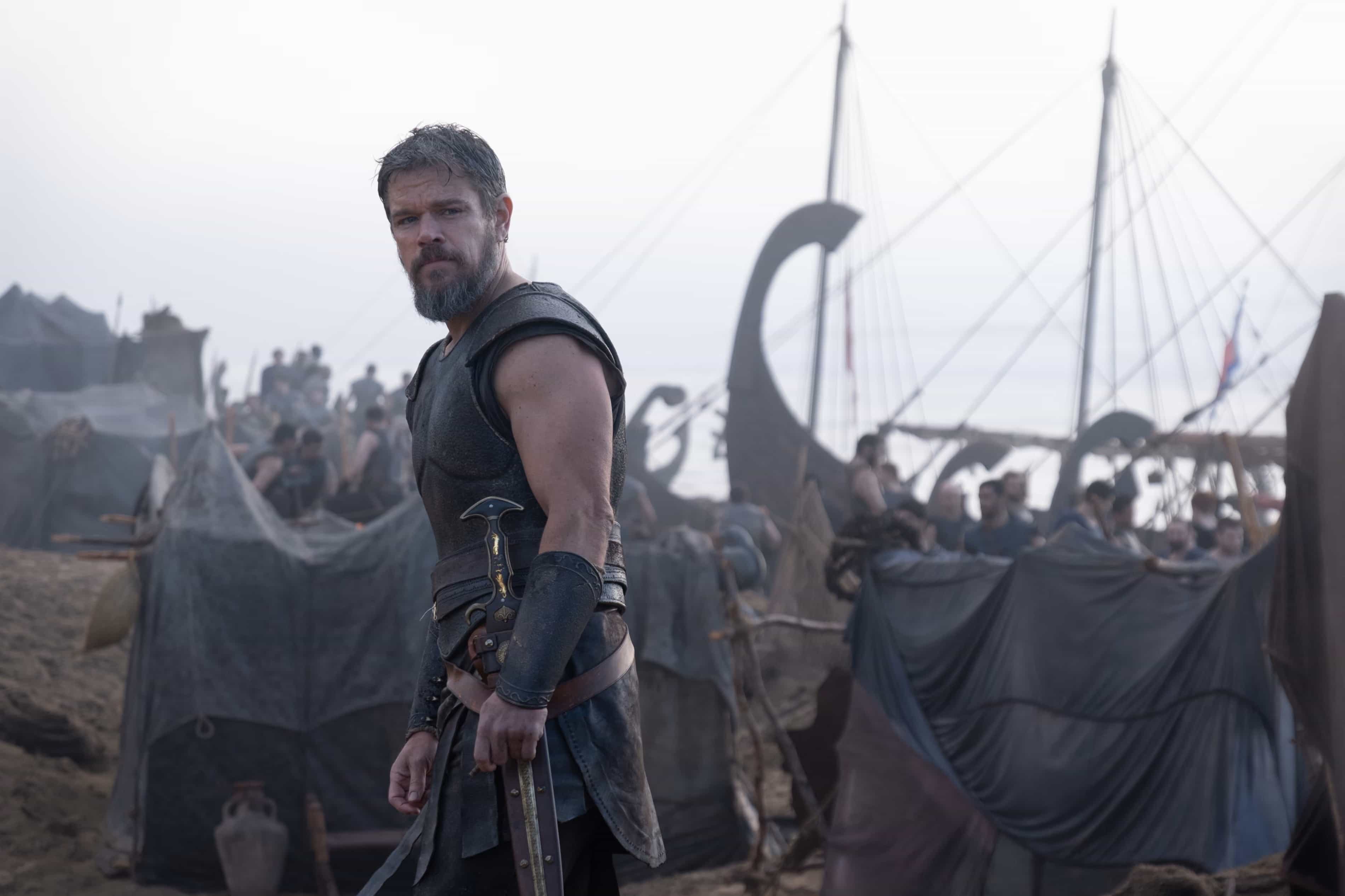
I did not mind the exclusion of characters like Laertes, or the lack of scenes involving the Olympians, or the exclusion of episodes such as Aeolus and the bag of winds, or the rolling of Calypso, The Lotus-eaters, and the Phaeacians into a single narrative function. I did not mind the “historical inaccuracies,” such as Helen of Troy being black (this is closer to mediterranean than much of the pasty cast) or Agammemnon’s armor (let’s be honest he looked sick as fuck). Artistic liberties are not only functional but necessary, which is why I found the Polyphemus episode particularly bothersome. In the epic poem, the Polyphemus episode is a classic example of Odysseus gassing himself up (he’s recounting the story to the Phaeacian court) and demonstrating his defining quality: his cunning. He is an arrogant trickster, Ὀδυσσεύς πολύμῆτις, Odysseus of many wiles, a refrained epithet in the poem; it is the quality behind both his heroics and hubris. It drives his successful escape from Polyphemus by calling himself a false name, and then revealing his actual one leads to direct consequences. Had he not been Odysseus, the escape would have involved fighting the wrath of several cyclopes, and the weather would have been fine thereafter since Poseidon wouldn’t know who to punish. In the film, there is nothing cunning about what Odysseus does to escape Polyphemus. By extension, his hubris does not move the plot forward. He stabs Polyphemus in the eye, shoots an extra arrow as he leaves, and then his soldier goes “oops! We made Poseidon mad, guess the weather is going to suck now!” The episode loses its weight—so why include it at all? Again, artistic liberties are necessary, and a good director has to pick their battles, lanes, and focuses when it comes to adaptations. The adaptation of the Polyphemus episode makes sense if the film isn’t actually about Odysseus, making his character traits less important. Given that the work is named after Odysseus himself, this is an interesting choice, though not necessarily a bad one (no less because Matt Damon was rather flat). Narratively, focusing less on character traits and development allows other elements to stand out, such as set pieces, plot, and theme. The first is a delight, and the main appeal of a film adaptation of the Odyssey, a visual adaptation of an aural work—an appropriate task for Nolan. The second is pretty much set in stone. The third is abominable.
I’m content to watch Nolan films once in theaters and never again—adequately worth such money and time. There is no other way to experience the effect of his direction than on a large screen. But his writing leaves something to be desired. Given his last three films, I’m questioning if Nolan remembers how to write a plot: Both The Odyssey and Oppenheimer sort of just happen and rely on already-known events, and Tenet was… Tenet. His characters vary widely (as Oppenheimer has Robert Downey Jr.’s Lewis Strauss to Florence Pugh’s Jean Tatlock, so here there is Robert Pattinson’s Antinous to Charlize Thereon’s Calypso), and his dialogue can sometimes be eyeroll inducing (“the age of bronze is ending”). Nolan is appropriately known more for his direction than writing, and as a writer, he’s not one to openly focus on moralizing or messaging—but when everything else falls through the cracks, it stands exposed. The Odyssey is Nolan’s third strike on bringing forth a dangerous idea: that “civilization” succumbs to barbarism as a deviation, an error, a fall, a “break,” and excludes the possibility that civilization is itself inherently barbaric.
The first strike was The Dark Knight Rises, where the arrival and deeds of Bane are the devolution of Gotham into barbaric disorder. Thanks to David Graeber, I can never watch this movie again because I can’t unsee it as pro-establishment propaganda that unfairly characterizes and responds to the Occupy! movement (Bane and his grunts literally occupy and manipulate the stock exchange. They exile the elite. The literal police triumph over them in a heroic showdown). The second was Oppenheimer, where the decision to build the atomic bomb “ends the world,” per Oppenheimer in the film’s final scene. The Odyssey (2026) is the third, where the breakdown of Zeus’ Law (ξενία) hearkens the end of the bronze age, with the sacking of Troy as its harbinger. Obviously, the implication is not “this specific thing happened and then it all went to shit;” with only a few hours at most, films exploring such themes revolve around some synecdochic catastrophe to provoke its audience, while leaving much of the world’s background on the cutting room floor. These constraints are devilishly useful because it shoves a lot of the context on which the work is dependent into our imagination—the only place in which many of these non-existent things are possible. Here, this is civilization itself—a breakdown or from civilization makes no sense without a civilization to break in the first place, a status quo to which catastrophe befalls. Such an idea is textbook culture industry—the unsung tragic hero is the present order which simply is and does not exhibit any particular qualities, they are forced into our imagination so that we can make sense of what is being shown to us. There is no Gotham without crime, there is no United States without warmongers, there is no mediterranean without inhospitable guests and hosts, even though each film is dependent on such idyllic histories. Catastrophe ceases to be a catastrophe if it’s par for the world’s course. These histories and backgrounds are as non-existent in the film as they are implausible in reality. Gotham is a fictional city that has only ever been crime ridden, the United States was built on the foundation of a slave economy, genocide of indigenous people, and an aristocratic government that betrays its democratic citizenry, and the Homeric epics are literally about war which a civilization built on raping, pillaging, and slavery claims as its heritage.
The Odyssey, for its part, is at least consistent with its historical values. The first story Odysseus himself tells is how his company raped and pillaged a city on their way home from Troy, women are portrayed as devious, licentious whores (Calypso actually holds Odysseus against his will, and he sleeps with Circe for a year as part of a deal to turn his men back from being hogs), and the triumphant return to Ithaca when the suitors are slain was even more brutal than it was portrayed in Nolan’s film (after which Telemachus hangs a bunch of slave women). The only thing better is the Aeneid, which has all of this and more, and is explicitly about the founding of civilization by a virtuous man who succumbs to violent wrath. Epic poetry is indeed the heritage of Western Civilization; it is Western literature par excellence. It is dishonest to portray its myths otherwise, to have them extol virtue.
“Sure, but this is a movie,” is the eternal refrain. Besides, did we not just justify artistic license? It doesn’t need to be a faithful adaptation, literally or thematically. It is a modern adaptation—of a myth, no less—is it not only acceptable, but ideal to adapt and portray it otherwise? Sure. But that doesn’t protect it from value judgments, and it doesn’t prevent it from producing ideological garbage. It’s not dangerous and bad because it doesn’t depict a more faithful, more brutal Odyssey—that’s probably for the best. It’s bad because of what’s left without it, and what therefore takes its place: the valorization of a mythical status quo. It is the sinister undergirding of both traditionalist reviews that take heart and warmth in the idyllic Western traditions so portrayed in the film and the inevitable onslaught of nauseating video essays about Zeus’ law and xenophobia and immigration. Both “sides” extol the virtues of a status quo and do equivalent ideological harm. While Nolan is not responsible for such content, he is responsible for their conditions—and therefore the reproduction of ideology.
The last few times I’ve reviewed a movie, I’ve said that one of the most dangerous and delusional presuppositions is the idea that a film or cultural artifact can exist independently of the context in which it is produced—ignorance thereof is inexcusable. I would like to go a step further and say that because we are constantly aware of and constantly interpret our immediate context (we would otherwise literally die), which includes our historical context, we—filmmakers included—cannot pretend that we’re clueless to the potential impact of a cultural artifact. In other words, we can’t pretend that we’re stupid and that we don’t make inferences and assumptions. Filmmakers are therefore not only justified, but obliged to consider the index of potential interpretations of their work as it relates to their present historical occasion—even if they end up terribly off the mark. Mentally, we can still separate—but never sever—the art from its artist and context. This is an important mental faculty that allows us to appreciate artistic craft and actually watch the movie without getting bogged down about things like its production in the Western Sahara. But powerful though our minds may be, suspend for however long we will, we must eventually leave the theater, and our minds must eventually come back to earth. Neither Nolan nor any other filmmaker can pretend that they are unaware of the planet on which they live, the fact that their work has an impact upon it, and also what that impact might be. And on a literally burning planet that impact might be disastrous. In times of crisis, the burden that history places on artists becomes particularly heavy and unfair. But history cares not. No human in any capacity is free from its constraints, no politicians, no citizens, no critics, no artists. You can make whatever movie you want. That is no sin. You cannot control how it appears to people; how people see and read it, and I’m sure many filmmakers accept that. You cannot, however, be naive to any idea on what such appearances and readings might be. Pretending to be ignorant or otherwise using your imagination to liberate yourself from reality to write the story you want is just as well as playing it cavalier. And effective directors aren’t arbitrary. They make conscious choices. They literally direct.
So at this point, I can’t help but wonder that Nolan is actually trying to say something with his movies. Sure, he’s no Jordan Peterson clinging and weeping to the traditions and idols of Western Civilization like fetish objects. And I’m pretty sure I’m still in the minority camp with the whole “Western Civilization is inherently barbaric” thing. It would be just as naïve of me to insist on this point for filmmakers and audiences, and it’s also a sliding scale. I don’t actually hate everything, believe it or not, and I’m sure that anyone, especially women and minorities, can come up with some grievous thing integral to history that they have to lay at the feet of the West. I’m merely asking that we at least entertain the idea. Nolan, however, seems bent on excluding that possibility altogether. Obviously that’s a conjecture that I can never be sure of. But the decisions he made in adapting the Odyssey were conscious decisions. In this historical moment, those decisions are decidedly in favor of the culture industry. Narratively, the best thing on can say about Nolan’s The Odyssey is that it ends.
Because, ironically, that’s the one part that’s completely different.
The most arrogant thing a man can do is think. It is a dangerous activity that does society little good. Besides, he doesn’t need to—he can just use violence instead. This, I suppose, sometimes makes thinking the less dangerous option, but that doesn’t change its destructive quality—in the mind, one’s entire world must break down in order to make sense of it, and you yourself may not survive; you might get lost; you might get paralyzed, and even upon your return you may have little more than dust to show for it.
To think is to wage war on the imagination. There is a disruption, a rupture, perhaps minor, contrived, and something stupid, but it cannot be stood, it must be corrected, order must be restored, but first it must be broken down. The scattered arsenal and armies of the mind are summoned in full force to besiege the site of the anomaly. They set sail on the sea of consciousness. The entire world is left behind, for one must leave it to break it apart, even if that is through a rupture within. Family, friends, house, home, city, society, position, the whole world is suspended and abandoned for this all but fated and fatal journey. It is a dangerous privilege for a man to suspend the world for so long to entertain his mind’s devices. In leaving the world behind he loses touch and ceases to learn; ceases to grow the faculty that has allowed him to leave in the first place. While man constantly engages in grand designs and fails again and again to break down the walls of the world, the underclass which supports this endeavor is fighting for their lives and their world tooth and nail against fiends, where true thinking is impossible, there are only brief interstitial and liminal blips to be creative for survival. For them, thinking outside of the world is impossible. For them, not the world of the imagination but the actual world is their adversary. In many cases, this makes them more knowledgeable than the man who has all the freedom and time in the world to entertain his vain pursuits.
Finally, there is a breakthrough! By the efforts of one’s cunning the perplexity is cracked opened, the bar of judgment falls, the world breaks down from within, the plague and domination and cause that has been the ill of all human beings for better and worse has been analyzed down to a science and makes its fall inevitable. After years and years of fruitlessness finally something is achieved in what seems like a single day. Even if empty handed man can finally return to the world triumphant. But the journey home is harrowing. A great sea of time and space has separated man from the world he calls his home. It is most unlikely that his return will be straightforward and peaceful, if at all certain. Great trials and tribulations await that may thwart his whole efforts. The unexpected and surreal wreak havoc upon him and strike down his spoils and comrades. The glorious thought he thought he had becomes questionable: was it all worth it? Do you truly know the codes of the world when it is constantly coming to bear trials and tribulations upon you? Paralysis. Captivation. Distraction. Many turns, backwards and forwards. Hard decisions, sacrifices. And the burning and destruction of the world becomes more and more apparent. Monsters and deceit abound left and right; he is blown all around in directions disorienting. He is lost and has lost and is losing: comrades, life, stability, sanity, memory. What has become of what he left behind? What has become of himself? Has he changed, or has he merely discovered himself, the one endowed with the capacity to both bear and inflict suffering? Destruction destruction destruction Death Death Death the world Drowns Drowns Drowns Drowns Drowns swallowed up by a rising sea of both consciousness and nature. Yet he remains afloat on scraps, as if it were a curse to live. He has lost everything but himself, and even that is questionable. But questions have destroyed him so much already, why does he continue to sail, to journey, as if anything will change, as if there is anything to be gained? Was the fruitlessness not proved already?
The return to the world from the journey of thinking is a disorienting jolt and a homecoming most unwelcome. He is loathed and resented by many, sometimes even those he loved—for who is responsible for the world he left behind? He returns haggard and empty handed with naught but an idea and a bundle of perplexities, and he is to be celebrated and called victorious? No, this cannot stand, this cannot be, not another idea, if he is to rule the same way with this we will surely die, so he must fall instead. In a way this is inevitable. If he keeps his morality the old king still dies, for man can only return amongst the dispossessed and underclass if they will have him, he must forfeit all worldly possessions and stations and every identity and who he is—and it will be easy, for he has already lost much—leaving only his consciousness. But consciousness does not rule from on high, it acts, it adapts, it employs wit and not strength, its weapons are not of force but of guile, for this is how those who have supported but are themselves suppressed by the world have survived since long before man left. Nevertheless, a confrontation with the old world is inevitable. And it is a clash, a melee; the barrage of the arsenal of the mind on oneself done in thought is the dress rehearsal for the grand crossfire in the world where the literally unimaginable forces are unleashed. In a literal or metaphorical slaughter the world reckons with a new and perplexing idea to refine it, negate it, revise it, bring it back, bring it forward, deconstruct it, reconstruct it, recombine it, it is its final test, its last stand, it has survived the tribulations of man, now it must survive the trials of men, the forces seem inexhaustible and endless—but they have been seen before, they are known well, they can be outsmarted, after everything conceivable falls at the feet of thought all that remains is a test of stamina—is there enough life left in the world to support it?
Amongst a floor in a ruined kingdom covered in blood and ash and dust stands a gem most refined yet flawed, perhaps hardly a carat worth carrying about. Was it all worth it? One can’t be sure. One can’t know if its beauty and the spirit which brought it into being will be yet appreciated. It may be treasured, it may start yet another war, or it may be trampled underfoot. For now it will be preserved in the kingdom’s reliquary with all of the others, as if soon this collection will summon something, as sometimes it does. So will he now stay to guard it? Has he earned his rest? Does he now know the forces of destruction of which he is himself a part, has he enough sorrow and lament to know no further? Is it time for penance, to not only live among men, but among the whole world of his fellow human beings, the underclass and dispossessed who hold it up like Atlas? Having finally been recalled, what is he to do?
He sets sail again, in the other bloody direction!