Modern Ahab: Chris Hansen
Dom Rottman
22 October 2026
I was five shots of rum and a cup of coffee in on a sweltering evening in Myrtle Beach. I found the trailer for Primetime on my YouTube feed, in the bathroom, mere hours after its upload. I was extremely vulnerable. I was perfect prey for the culture industry’s charms—and when I saw Robert Pattinson as Chris Hansen, I was enchanted. The trailer’s colors, production design, cinematography, editing, were a sea of consciousness that held the image of Chris Hansen afloat—not as he actually was, but as he is remembered. I loathe biopics, even critical ones such as Adam Mckay’s Vice, but my consciousness, swept away by either the alcohol or salty waters, gave in to the undertow, drawn in by this mythic figure. And who could this magnetic figure on the waters be other than Captain Ahab?
Moby-Dick is one of those books that haunts my shelf demanding that it be reread. My AP English peers and I were far too young to grasp what this wicked book had to offer. Still, the essay we had to write on it had a mythical status of its own: an analysis of water imagery that had to also address the concept of the “collective unconsciousness,” notorious for being evaluated with a captain’s rigor. I did well, but had I been the good Hegelian that I am now (god help me), I would have torn this essay to shreds and dismissed the collective unconsciousness in favor of recognition and Dialectics™. The water is important. The water-gazer beholds a murky, undulating reflection and always fails to understand herself; it is why Moby-Dick is written from the perspective of Ishmael, Ahab’s “other,” rather than Ahab himself, the protagonist. Indulge me in some traditional literary criticism of Primetime before placing it in its material context.
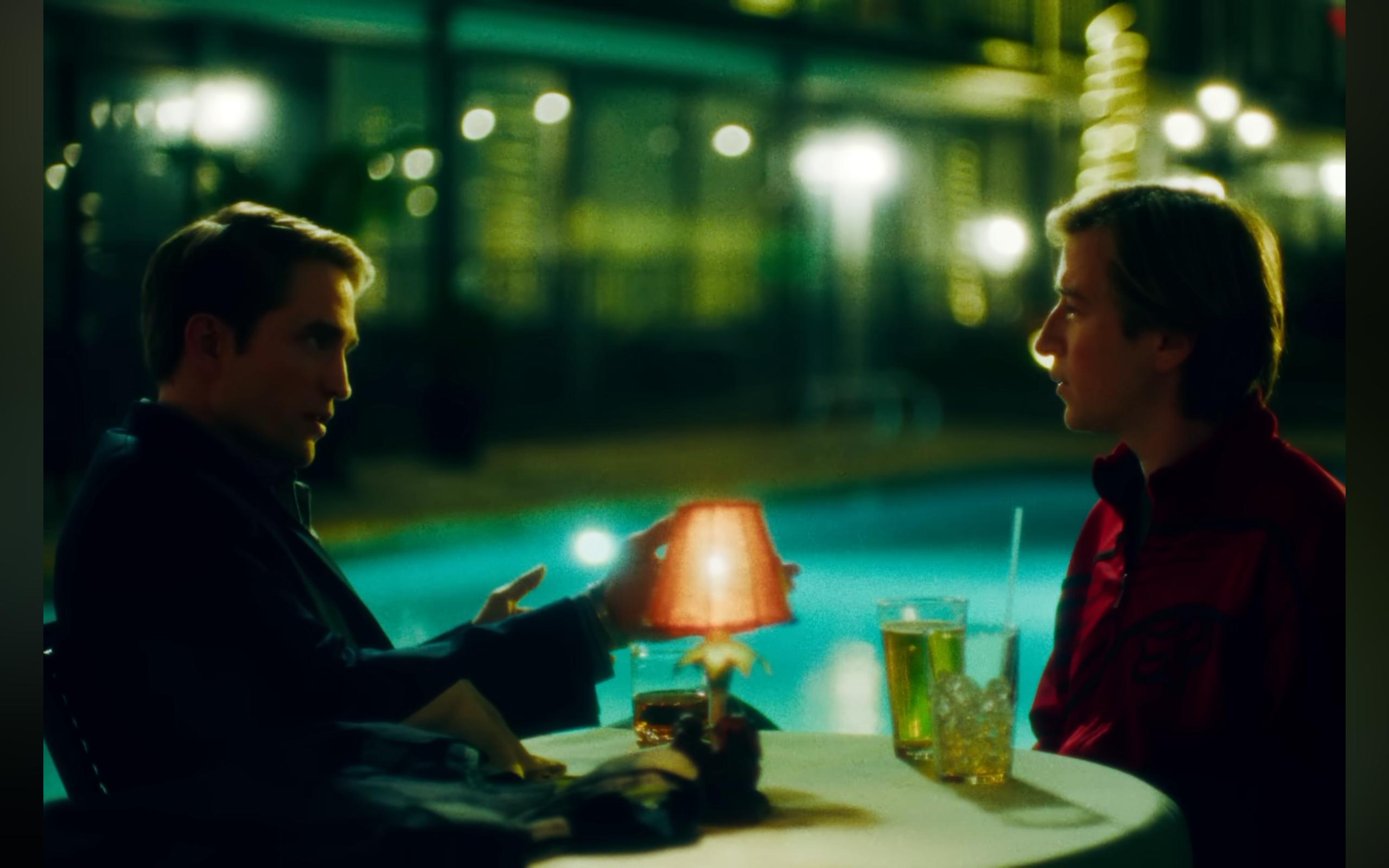
There are two particular scenes with swimming pools where Chris Hansen is joined by his “other,” “Decoy” Dan Plum. The first is their first official meeting which opens with an aerial shot of a hotel dining area courtyard in Florida. A bright blue swimming pool illuminates an otherwise dim area. It is the dominant of several caustics produced by glasses on the tables and the beers that the two order. The light sources are themselves blurred; the distortions and the colors are what catches the eye. Chris himself is dressed in dark clothes in contrast to his pale face, facing Decoy Dan whose back is to the pool, figure dimmed by the light of the water behind him and blurred lamps and warm lights in the background. Chris quickly acquires an affinity for Dan because he recognizes himself in him. Dan reminds Chris of his son, not because of any resemblance but because Dan is an extension of who he wants to be and what he wants to do. He cannot be both catcher and bait. But as his actor, Dan is an empty vessel so hollow that he is not even officially an actor, and thus a perfect vehicle for Chris’s ego. Every time Chris talks to Dan it is as if Chris is talking to himself, so much so that it will be Dan’s body who relives Chris’s experience reporting on child labor in India and his encounter with an “ancient evil,” an experience that Chris reminds himself with a totem bracelet that he gives to Dan. Decoy Dan is Chris Hansen’s reflection pool, a narrow recognition that does not recognize the other as a full person but only insofar as the other reflects oneself. It admits the fluidity and volatility of one’s ego but not its relationship to others.
Caustics and pool water are not as expansive and nebulous as the ocean but are just as distortive. The 2006 we see in Primetime is the way we remember it but hardly natural. The colors are vibrant but slightly off-putting; 4:3, once ubiquitous, is discomforting, narrow, and confining. We get the sense that we are literally not seeing the whole picture. It is impossible to recognize, authentically, who we once were. The second important scene with Chris, Dan, and a swimming pool is at the sting house set up in Texas, where Chris has by now given in fully to his desire to slay a (white) whale—a child predator with proper political power. The sink water cannot refresh him. His producer, the Starbuck to his Ahab, informs him that they are hundreds of thousands of dollars in the hole. At this point, an exasperated and exhausted Chris, suitless and with battle vest laid bare, pared down to nothing but his obsession, explains to Dan how the pillory of old has transformed to television, ambiguous on whether the subjects of spectacle are the predators they catch or they themselves. The television: a perfect companion for a distorted reality. No matter how much we might see ourselves in characters and reporters and see our world hundreds of miles beyond our ordinary scope, it presents a widely broadcast image in which no human being is actually present and to which we cannot reply. There is no genuine growth. The subjects of television cannot incorporate how the public recognizes them, and the public cannot grow beyond what they initially recognize on television. A false or distorted image of reality is more convincing on television because there is nothing else to be believed, and arrests the possibility of imagining a world otherwise. The substitution of the television for everything from the theatre to the pillory eliminates recognition between human beings and reduces it to viewer and viewed, where the former is free to buy into and imagine distortions of herself, and the latter is free to produce false images and idols.
By now Chris and Dan fail to recognize each other. Chris is too inundated in his distorted sense of righteousness to see anything but his own twisted reflection and his mission to kill the white whale. Dan returns the totem to Chris, realizing that he is failing to become his own person after doing his very own Chris Hansen impression on a different predator. A camera, a device meant to capture reality as it actually appears, is submerged in favor of the water, in much the same way that the mythical Chris Hansen swallows and is favored over the historical Chris Hansen. It is to this decision which we now turn.
It is worth remembering that Primetime is not based on Chris Hansen’s work for Dateline NBC as such. It is based on the Esquire article “Tonight on Dateline This Man Will Die”—a harrowing title that I reminded myself of throughout the film to center myself on an otherwise meandering track. Almost nobody, including both director Lance Oppenheim and Chris Hansen himself, is keen to point this out, nor was the film marketed as such, instead claiming that Primetime is “based on true events.” The tone and foundation of the film is therefore not just lost on but hidden from the audience. It is currently hip among the terminally online to bemoan a modern media illiteracy crisis. I find this unfair, if not insulting, especially when it comes to film. It is an industry which literally—and can only—produce false images of reality, and has been historically used—sometimes quite explicitly—to fool people. The fact that the culture industry continues as an apparatus of deception presupposes a basic intelligence of an audience that can be convinced, and who might otherwise realize that the status quo is kind of shit and should be entirely different.
Primetime walks the intelligence of the audience on a tightrope. On the one hand, its intrigue baits moviegoers into the theater with its promise of a historical figure and “true events,” and does not attempt to dispel any false assumption held by the audience who might believe it to be based on Dateline. On the other hand, it assumes that the audience is intelligent enough to pierce the veil when the surreal, overdramatized image goes overboard enough to spark a skepticism of the film’s correspondence with reality—the very claim which drew them in in the first place. The moviegoers Chris Hansen interviews after seeing the film himself have no problem believing that “98% [of the film] was pure fiction,” and that the mythical figure on the screen was quite distinct from the man on the street.
Lance Oppenheim is no propagandist, but he has no delusions that what he’s producing is meant to resemble reality. He insists that who we are seeing is the myth of Chris Hansen. Remarking on how he refused to consult his subject, he “wanted to take the internet’s version of Chris Hansen,” where “at a certain point, people mythologize you.” Leaning into this idea is what I think makes Primetime ultimately a good film. Dispelling the illusion that the film must conform to some historical or material basis casts off a restraint that allows it to embrace the surreal, an unfiltered imagination so bizarre that it demands to be treated with skepticism. Tony, another recent A24 production, relies on the mythos of Anthony Bourdain like a crutch, using him as a historical name to prop up hollow bourgeois moralizing as somehow grounded. Without Anthony Bourdain you have a film about a schmucky, nerve-grating teenager that by learning the value of honesty and hard work (but obviously not the actual material experience of the working class) gets his start for a prestigious culinary career; a Horatio Alger-esque portrait that would without Bourdain be as unbelievable in the imagination as it is in history. Without Chris Hansen in Primetime, you have a psychological thriller about a journalist in the mold of Captain Ahab, struggling with his justice-driven ego and obsession with an inscrutable evil. The invocation of history does not change a film’s myth, but it impacts the degree to which it can be believed. That’s not to say “historical” myths in film are necessarily more believable. Tony is more believable because it universalizes the particular experience of Anthony Bourdain. Primetime does the opposite: by naming the protagonist Chris Hansen, by subsuming a particular historical figure in the surreal and overdramatic, the film becomes more difficult to take seriously because even an audience that believes it to be based on “true events” could not reasonably take what they saw as historical. To this extent, Primetime fails to sell the Mythology of Chris Hansen as “true,” but it does not attempt to sell anything more. And in terms of peddling myths, you can do a lot worse than Chris Hansen.
The material history of what Chris Hansen did makes us treat Primetime with some skepticism, and that is enough. In so doing the very idea that films correspond–and must correspond–with reality and the power of the status quo is called into question. The film is thus more vaccine than virus. No, Chris Hansen is not a ratings or justice-driven egomaniac. He is a professional who has shot down a missile battery of attempts to either ragebait him over the film or cave to a profit motive. And being a professional has its consequences, especially when you’re on TV. One is materially and ideologically contained in a fishbowl where the claim “this is water” is a dangerous misdirection from the glass barriers and the vast horror of reality they separate. There are nearly endless fish in the sea while whales are protected and watched. Likewise neither the historical Chris Hansen nor Chris Hansen the myth have had a significant material impact on their object: putting an end to the widespread violence of child predation as the bed of authority. The kernel of truth is at the point of Ahab’s harpoon, where the real and mythical converge, aimed at an inscrutable malice fated to escape our capture.